Search Our Content Library
- Accredited Learning
- Adobe
- AI in AECO+D&M
- Arch-Intelligence
- Autodesk
- Autodesk Construction Cloud
- AVAIL
- Bentley
- Bluebeam
- Business & Management Skills
- Camtasia
- Enscape
- Esri
- EVOLVE MEP
- Global BIM Standards
- Green Badger
- Guardian
- Health & Safety (HSI)
- Ideate Software
- Lumion
- Manufacturing Design
- MarkedUp
- McNeel
- Microsoft
- Newforma
- Newforma Konekt
- OneClick LCA
- Panzura
- Pinnacle Series
- Procore
- Project Management
- Revizto
- SketchUp
- SmartDraft
- Solibri
- SOLIDWORKS
- Tekla
- Trimble
- Twinmotion
- US Army Corps of Engineers
- V-Ray
- Course Library
- /
- Bentley Learn MicroStation
- /
- Mastering MicroStation for General Users
Learning Path Courses:
-
Ch. 12: Printing and Publishing
Ch. 12: Printing and Publishing covers producing final output from a design, printing a sheet model using a print composition to PDF, and printing directly from a design model. -
Ch. 11: Composing Designs and Sheets
Ch. 11: Composing Designs and Sheets covers composing designs from multiple sources: attaching and controlling references, including nested and activated references, attaching raster images and PDF documents, and building sheet models with borders and print compositions.
-
Ch. 10: Annotating Designs
Ch. 10: Annotating Designs covers annotating a design with text and dimensions, placing and editing text with different styles, methods, and annotation scale, placing and changing dimensions, and applying and changing area patterns.
-
Ch. 9: Working with Cells
Ch. 9: Working with Cells covers placing and working with cells, MicroStation's reusable symbol elements, including line terminators, creating new cells, editing existing cells, and replacing cells throughout a design. -
Ch. 8: Modifying Elements
Ch. 8: Modifying Elements covers tools for reshaping existing elements, including modify element, inserting and deleting vertices, breaking elements, trimming and extending lines, and constructing fillets and chamfers.
-
Ch. 7: Manipulating Elements
Ch. 7: Manipulating Elements covers the core element manipulation tools used to arrange and adjust a design: copy, move, move/copy parallel, mirror, rotate, scale, array, and stretch.
-
Ch. 5: Creating Basic Drawing Elements
Ch. 5: Creating Basic Drawing Elements covers placing core drawing elements, including SmartLines, blocks, circles, and arcs, along with creating complex shapes and chains, dropping elements, and creating regions. -
Ch. 6: Selecting Elements
Ch. 6: Selecting Elements covers the different ways to select elements in MicroStation, including the Element Selection tool, working with multiple selected elements, fence selection, and selecting elements by their attributes. -
Ch. 4: Precision Drawing with AccuDraw and AccuSnap
Ch. 4: Precision Drawing with AccuDraw and AccuSnap introduces AccuSnap element snapping and additional snap modes alongside AccuDraw, MicroStation's coordinate entry tool, to support fast and accurate drawing. -
Ch. 3: Controlling the Display of Designs
Ch. 3: Controlling the Display of Designs covers core view controls such as zoom, fit, window area, and pan, additional mouse-driven view controls, working with multiple view windows, and controlling what's visible through view attributes and level display. -
Ch. 2: Defining Element Attributes
Ch. 2: Defining Element Attributes covers setting element attributes with ByLevel symbology, changing and matching attributes between elements, creating filled elements, and applying transparency and display priority. -
Ch. 1: Using General Tools
Ch. 1: Using General Tools covers the fundamentals of starting MicroStation and navigating its interface and models, then moves into core drawing tools, undo/redo, saving and compressing design files, creating new files and models, and measuring elements.
Like what you see? We’d love to give you a guided tour of the best Pinnacle has to offer.
Book Your DemoTrusted By Leaders









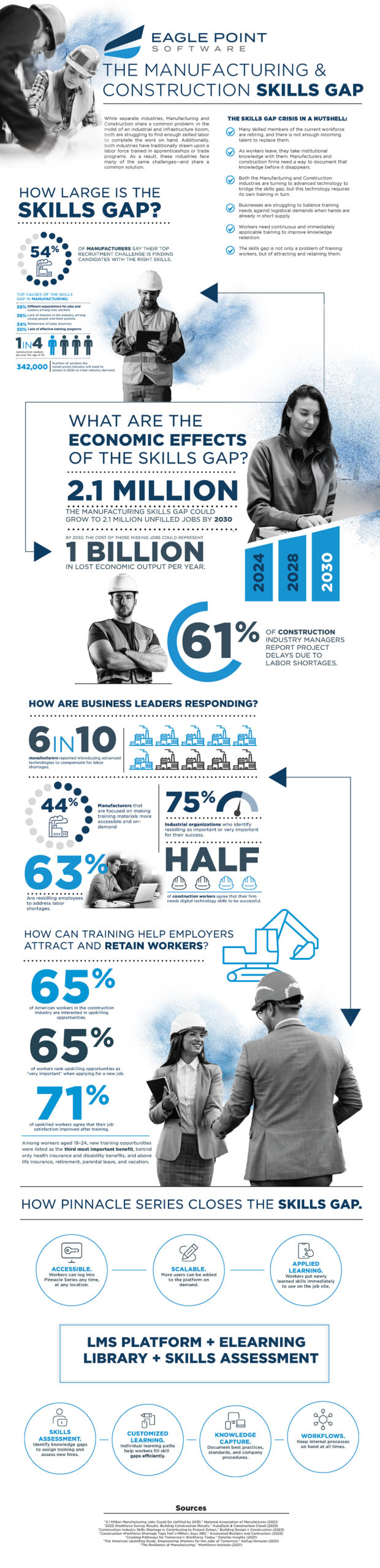
Understanding the Manufacturing & Construction Skills Gap
We went deep into the latest market research and created a resource to give you fresh insight into your recruitment challenges.